|
|
|
|
|
 |
|
|
|
|
|
|
|
|
Battle of Agincourt
Cranston Military Prints  By Subject Military Art Medieval History By Subject Military Art Medieval History  Battle of Agincourt Battle of Agincourt |
[UP] - Viking History - Battle of Hastings - Richard the Lionheart - William Wallace - Robert the Bruce - Battle of Crecy - Owain Glyndwr - Battle of Agincourt - Joan of Arc - War of the Roses - Samurai - Medieval History Print List |
| A collection of artwork of the Battle of Agincourt, Henry V's great victory over superior French forces in 1415. |
|
|
|
|
|
|
|
|
| Text for the above items : |
With Banners Bravely Spread by Sir John Gilbert. No text for this item |
The Battle of Agincourt by Brian Palmer. The French Knights attack Henry Vs English infantry lines and are repelled during the Battle of Agincourt, a victory for Henry V. |
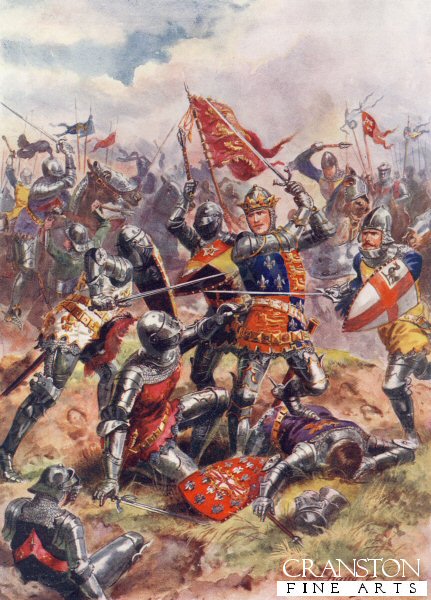
King Henry V Fights With Heroic Valour, Battle of Agincourt by Harry Payne. No text for this item |
Morning of Agincourt by Sir John Gilbert. Battle of Agincourt, October 25th 1415. Fought during the Hundred years war at the end of the English Invasion of 1415. King Henry the V of England, after his conquest of Harfleur marched his army of 1,000 Knights and 5,000 Archers (many of which were Welsh) towards Calais. He marched to Amiens as flooding had affected the river at the Somme which was the direct route. This delay helped the French army of 20,000 strong under the command of the Constable Charles dAlbret and Marshal Jean Bouciquaut II. The French army blocked Henry V route to Calais, giving the English no choice but to fight. Henry V positioned his army at Agincourt, between to wooded areas giving a frontage of 1100 metres. Henry deployed his force into three divisions; each group had archers at each flank. He had chosen his position well, in front of his army was ploughed fields and due to the heavy raid was very muddy. Due to the narrow battlefield area the French army lost their advantage of superior numbers. At 11 oclock the English started to advance their archers within 2509 yards of the French, getting them into range of the French lines. The French line of Cavalry advanced at a slow pass due to the heavy mud, They took heavy losses from the arrows from the English Long Bowman. They were eventually repulsed by the Archers who as the French cavalry approached changed from using longbows for axes and swords. The French second Cavalry line advanced only to be finally repulsed after hand to hand fighting. The commander Duc dAlencon was killed in the attack. The second charge had failed and many of the French knights were taken prisoner. Believing he had been attacked in the rear Henry V ordered that the prisoners were to be put to death. In fact There was no real rear attack it was French Camp followers plundering the English Camp. The French camp followers were quickly dealt with and the English again prepared itself for the next attack. The third attack never materialized as the sight of so much blood shed and piles of corpses turned the charge into a retreat. The English had won the day with losses less than 1600 compared to the French losses of over 7,000, including the capture of Bouciquaut. Henry V, his way now cleared reached Calais on the 16th November 1415. Agincourt is one of the great battles of military history, and this victory enabled Henry V to return to France in 1417 and conquer all of Normandy. |
King Henry V at the Battle of Agincourt by Sir John Gilbert. Battle of Agincourt, October 25th 1415. Fought during the Hundred years war at the end of the English Invasion of 1415. King Henry the V of England, after his conquest of Harfleur marched his army of 1,000 Knights and 5,000 Archers (many of which were Welsh) towards Calais. He marched to Amiens as flooding had affected the river at the Somme which was the direct route. This delay helped the French army of 20,000 strong under the command of the Constable Charles dAlbret and Marshal Jean Bouciquaut II. The French army blocked Henry V route to Calais, giving the English no choice but to fight. Henry V positioned his army at Agincourt, between to wooded areas giving a frontage of 1100 metres. Henry deployed his force into three divisions; each group had archers at each flank. He had chosen his position well, in front of his army was ploughed fields and due to the heavy raid was very muddy. Due to the narrow battlefield area the French army lost their advantage of superior numbers. At 11 oclock the English started to advance their archers within 2509 yards of the French, getting them into range of the French lines. The French line of Cavalry advanced at a slow pass due to the heavy mud, They took heavy losses from the arrows from the English Long Bowman. They were eventually repulsed by the Archers who as the French cavalry approached changed from using longbows for axes and swords. The French second Cavalry line advanced only to be finally repulsed after hand to hand fighting. The commander Duc dAlencon was killed in the attack. The second charge had failed and many of the French knights were taken prisoner. Believing he had been attacked in the rear Henry V ordered that the prisoners were to be put to death. In fact There was no real rear attack it was French Camp followers plundering the English Camp. The French camp followers were quickly dealt with and the English again prepared itself for the next attack. The third attack never materialized as the sight of so much blood shed and piles of corpses turned the charge into a retreat. The English had won the day with losses less than 1600 compared to the French losses of over 7,000, including the capture of Bouciquaut. Henry V, his way now cleared reached Calais on the 16th November 1415. Agincourt is one of the great battles of military history, and this victory enabled Henry V to return to France in 1417 and conquer all of Normandy. |
Agincourt 1415 - The Triumph of the Longbow Banners advance! KING HENRY AT AGINCOURT. On October 25th 1415, as the pale dawn of an early autumn day broke over Agincourt, a mighty French army numbering 30,000 men surveyed the small English force who stood before them ready to battle. The French expected a swift and comprehensive victory, but as a day of great savagery unfolded, it was the English led by their charismatic King, Henry V, who would utterly destroy their enemy. This DVD features a superb and accurate reconstruction of the great battle, plus dramatised eye-witness accounts taken from contemporary records. State-of-the-art mapping techniques, period imagery and expert comment and analysis from Dr David Chandler provide an informative and entertaining account of this savage battle. Narrated by Brian Blessed |
Battle of Agincourt, 1415 by Henry Dupray. No text for this item |
Agincourt 1415. Immortalized by Shakespeare, Agincourt is an epic of courage and hard fighting. Brought to bay after the long siege of Harfleur, Henry V's army was soaked, starving and riddled with disease, and facing a French army at odds of more than 3 to 1. How the English beat off their attackers and slaughtered the flower of French nobility is vividly described in this volume. Matthew Bennett is a lecturer at the RMA Sandhurst and a specialist in medieval military history. |
|
Contact Details |
|
Sign Up To Our Newsletter!
This website is owned by Cranston Fine Arts. Torwood House, Torwoodhill Road, Rhu, Helensburgh, Scotland, G848LE Contact: Tel: (+44) (0) 1436 820269. Email: cranstonorders -at- outlook.com
|
|
|