|
|
|
|
|
 |
|
|
|
|
|
|
|
|
Battle of Trafalgar
Cranston Military Prints  By Subject Naval Art Age of Sail By Subject Naval Art Age of Sail  Trafalgar Trafalgar |
[UP] - Algiers - St Jean D'Acre - Cape St Vincent - Copeland Islands - Copenhagen - Finnisterre - Glorious 1st of June - Helgoland - Malaga - The Nile - San Domingo - Texel - Trafalgar - Spanish Armada - Ships - Age of Sail Print List |
| Battle of Trafalgar. Age of Sail naval art prints of the Battle of Trafalgar. |
| Navigation | |
| Page 2 of 4 | Previous .. Page 2 .. Next |
|
|
|
|
|
|
|
|
|
|
|
|
|
|
|
|
|
|
|
|
|
| Navigation | |
| Page 2 of 4 | Previous .. Page 2 .. Next |
| Text for the above items : |
Breaking the Line by Ivan Berryman. Just seconds from opening fire with a broadside that will devastate her opponent, HMS Victory prepares to pass the stern of the French flagship Bucentaure, closely followed by the three-deckers HMS Temeraire and HMS Neptune. With guns unable to bear on the enemy fleet during the slow approach the British ships had endured terrible punishment with Victorys sails holed, her wheel smashed and her mizzen top shot away. |
Prelude to Trafalgar by Ivan Berryman. 21st October 1805. As Admiral Nelsons flagship leads the British fleet towards the Franco-Spanish line, Captain Harveys Temeraire tries to pass the Victory in order to be the first to break the enemy column. Harvey was discouraged with a customry rebuke from Nelson and duly fell into line behind the flagship. The enemy can be seen spread along the horizon whilst, to the right in the distance, the leading ships of Admiral Collingwoods fleet can be seen spearheading a separate assault to the south. In the light airs preceding the battle, much sail was needed to drive the British ships towards the enemy line. HMS Victory, nearest, has royals and stunsails set and is making good way, her furniture boats strung behind in readiness for battle. On her poop deck, officers prepare to run up a signal. |
The Battle of Copenhagen – HMS Glattons Bravest Day by Ivan Berryman. The battle of Copenhagen was long and hard-fought and Admiral Parker ordered Admiral Nelson to withdraw, an order that Nelson ignored. At one point a Danish frigate moved swiftly to attack Nelsons flagship HMS Elephant, but Captain Bligh of HMS Glatton sailed his ship directly into the broadside to protect the flagship. The Glatton, already displaying some damage, somehow survived the terrible barrage inflicted to its hull by the low-firing Danish vessel. The Elephant was saved and the battle eventually won with the unconditional capitulation of Denmark. It was surely Captain Blighs finest hour and an act of selfless bravery. In the background, HMS Bellona is aground on a sand bank, one of three British ships that failed to navigate the narrow channel. |
HMS Royal Sovereign by Ivan Berryman. (P) Admiral Cuthbert Collingwoods flagship the Royal Sovereign comes under intense fire from the black-painted Spanish 3-decker, Santa Ana, and the French 74 Fougueux, just prior to breaking through the Franco-Spanish line at Trafalgar. |
Nelsons Day, Battle of Trafalgar by Randall Wilson. Having broken the line of the French and Spanish ships, HMS Victory is about to lock horns with Redoubtable. |
Trafalgar: HMS Royal Sovereign Prepares to Break the Line by Ivan Berryman. Just minutes from opening fire, HMS Royal Sovereign, carrying the flag of Vice-Admiral Lord Cuthbert Collingwood, approaches the Franco-Spanish line at Trafalgar, prior to breaking through and delivering a devastating broadside into the black-painted Santa Ana. Royal Sovereign had already taken terrible punishment as it had approached the enemy line, unable to bring her own guns to bear. Ships depicted, left to right, are: Indomptable (Fr) Rhin (Fr) Santa Ana (Sp) Royal Sovereign (Br) and Fougeux (Fr) |
The Battle of Trafalgar by Montague Dawson. No text for this item |
Trafalgar Aftermath by Ivan Berryman. Ravaged by the combined guns of the allied French and Spanish fleets at Trafalgar and by the great storm that followed the battle, a weary battered HMS Victory enjoys the relative calm as crew from HMS Neptune are despatched to take up the tow from the 3rd rater HMS Polyphemus for the final leg of her journey to the safety of Gibraltar, the flagship still bearing the body of Admiral Lord Horatio Nelson. |
Battle of Trafalgar, 21st October 1805 - The Close of Action by Nicholas Pocock. The aerial view shows the scene of devastation at around 6pm with the British ships lying alongside their prizes in the foreground, and the remaining French ships fleeing in the distance. |
The Death of Nelson at the Battle of Trafalgar by Daniel Maclise. Admiral Horatio Nelson is seen lying on the deck of HMS Victory after being mortally wounded, hit in the shoulder with the bullet going down through his chest, fired from a French sniper high in the rigging of the French ship Redoubtable, which is entangled with HMS Victory during the later stages of the Battle of Trafalgar. The painting also shows in great detail British sailors performing their duties on board Victory and the French ships rigging entangled in that of Victory. French crew can be seen firing and fighting against the British. Admiral Nelson would be taken below decks where he would die as the battle was won. The original painting which is some 15 metres in length hangs in the Palace of Westminster. |
Nemesis by Ivan Berryman. Arguably the most iconic moment in British naval history, HMS Victory is depicted just moments from firing her devastating opening salvo into the stern galleries of the French flagship Bucentaure at Trafalgar as Nelson's flagship enters the fray at approximately 12.30pm on October 21st 1805. Beyond Victory, in the extreme distance through the gun smoke, Collingwood's Royal Sovereignis engaging the Santa Ana. To the left of the painting, the French Neptune and Spanish San Justo can be seen with Redoutable immediately beyond Victory, trying vainly to close the gap. Victory, already shot to pieces, is about to wreak her terrible revenge on the Bucentaure in the foreground where Vice-Admiral Villeneuve can be seen on the poop deck - wearing the green corduroy pantaloons. Nelson was surely the nemesis of Villeneuve, who had been summarily humiliated some seven years earlier at the Battle of the Nile and Nelson's tactics would again win the day for His Majesty's navy, albeit at the tragic cost of Nelson himself. |
The Death of Nelson by Benjamin Well (PC) Part of the classic collection. |
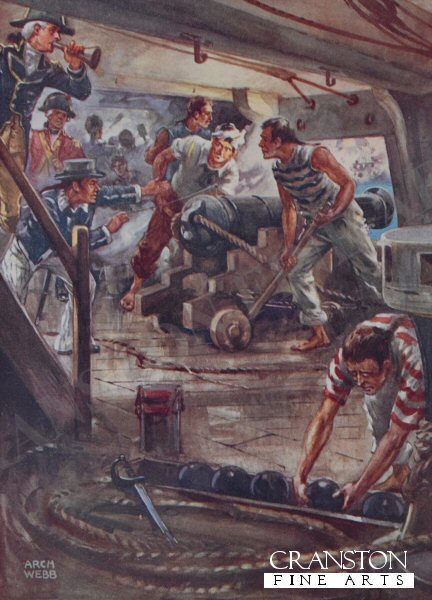
Each Gun From its Adamantine Lips by Archibald Webb British gun crews below decks, manning the cannons during the Battle of Trafalgar |
Trafalgar- The Destruction of The Bucentaure by Ivan Berryman. With her mizzen top already gone and her sails aloft having received severe punishment, Victory breaks through the line behind the French flagship Bucentaure, delivering a shattering broadside into her stern. So severe was this opening fire that the Bucentaure was effectively put out of the rest of the battle, although Admiral Villeneuve himself was to miraculously survive the carnage. Beyong Victory can be seen the French Redoubtable, which is receiving fire from Victorys starboard guns, and the Spanish San Leandro is in the extreme distance. Most of Victorys stunsails have been cut away, but it was her stunsail booms that became entangled with the rigging of the Redoubtable when she put her helm to port and ran onto her. Admiral Nelson fell shortly afterward, having received a fatal wound from a musket ball fired by a French sharpshooter in Redoubtables mizzen fighting top. The Temeraire can be seen approaching the fray to the right. |
Nelsons Victory at Trafalgar by Anthony Saunders Undoubtedly the most famous and decisive battle in the history of naval warfare. The battle of Trafalgar was fought on a calm, almost windless day, on 21st October 1805. Nelsons revolutionary battle plan was to cut apart the larger Franco-Spanish fleet of Vice-Admiral Villeneuve by sailing in two single column divisions directly at right angles into the combined fleet and thus rendering almost half of the leading ships useless until they could turn and join the fight, which in such calm conditions could take hours. The battle raged for five hours in which time not one British ship was lost, however, Nelson would tragically lose his life at the very moment of his triumph, a triumph which rendered the British Navy unchallenged in supremacy for over a century. Here, Nelsons flagship, HMS Victory, followed by HMS Temeraire is seen breaking the Franco-Spanish line and commencing her murderous hail of gun fire into the stern of Villeneuves flagship, Bucentaure. Meanwhile the Victory herself is being fired upon by the French Neptune. Redoutable can be seen at the far right. |
The Victorys Approach - Trafalgar 1805 by Barry Price. No text for this item |
The Hero of Trafalgar by William Hersman Overend. Depicting Nelson on the deck of HMS Victory, during the Battle of Trafalgar. |
Warm Work by Ivan Berryman. The time is approximately 12.20pm on 21st October 1805. HMS Victory forces her way through the combined Spanish and French line, firing all her larboard guns into the stern of Admiral Villeneuve’s flagship. Bucentaure was utterly destroyed by the initial salvo with twenty of her guns smashed off their mounts and over 300 of her crew left dead or disabled. But Victory herself had suffered much during the perilous approach to the enemy fleet. Unable to bring any guns to bear, she received multiple hits from the Franco-Spanish ships, bringing down her mizzen top, her fore topgallant mast, her studding sails and smashing the ship’s wheel. The bowsprit, part of her figurehead and catheads were shattered, her anchors carried away and the entire bow, headrails and beakhead were peppered with shot. The title of the painting refers to a comment made by Admiral Horatio Nelson as HMS Victory began to receive fire from the enemy. A piece of hot shrapnel tore the buckle off Nelson’s shoe as he paced the deck with Captain Hardy, to which he responded, “It is warm work today!” Sadly, just one hour later, Nelson was fatally wounded by a sharpshooter stationed on the mizzen top of the French Redoutable which can be seen to the left of the painting. The towering spectre of HMS Temeraire looms in the gunsmoke as she follows HMS Victory into the fray. |
Nerves of Steel by Ivan Berryman. Just moments from her devastating opening broadside, HMS Victory prepares to pass the stern of the French flagship, Bucentaure, to break through the line of the combined French and Spanish fleets as the Battle of Trafalgar begins on 21st October 1805. Victorys guns had remained silent until this moment, Lord Nelsons flagship having already suffered severe damage during the approach, but now the gun crews awaited the moment when her double-shotted cannon, her mighty 68-pounder carronade and a shower of musket balls would smash through the French vessel, rendering it at once a useless hulk. |
Admirals All by Arthur David McCormick (PC) Part of the classic collection. |
Breaking the Line at the Battle of Trafalgar by Graeme Lothian At 12.30pm on the 21st of October 1805, Admiral Lord Nelson on board his flagship, HMS Victory, breaks the line of the combined French and Spanish fleets. The Victory is delivering a devastating stern rake to the 80 gun French ship Bucentaure, the flagship of the combined fleets, commanded by Vice-Admiral P. C. J. B. S. Villeneuve. Starboard to the Victory is the 74 gun Redoutable. This ship, the Victory and HMS Temeraire, seen left, became locked together soon after, the unequal exchange resulting in the Redoutable having the highest casualties during the entire battle. |
| Navigation | |
| Page 2 of 4 | Previous .. Page 2 .. Next |
|
Contact Details |
|
Sign Up To Our Newsletter!
This website is owned by Cranston Fine Arts. Torwood House, Torwoodhill Road, Rhu, Helensburgh, Scotland, G848LE Contact: Tel: (+44) (0) 1436 820269. Email: cranstonorders -at- outlook.com
|
|
|