|
|
|
|
|
 |
|
|
|
|
|
|
|
|
WW2 Battleships Naval Art
Cranston Military Prints  By Subject Naval Art World War Two Ships By Subject Naval Art World War Two Ships  Battleships Battleships |
[UP] - Aircraft Carriers - Battleships - Cruisers - Submarines - Destroyers - Monitors - Torpedo Boats - Corvettes - Minesweepers - Auxiliaries - Landing Craft |
| World War Two naval art prints of battleships. |
| Navigation | |
| Page 3 of 7 | Previous .. Page 3 .. Next |
|
|
|
|
|
|
|
|
|
|
|
|
|
|
|
|
|
|
|
|
|
| Navigation | |
| Page 3 of 7 | Previous .. Page 3 .. Next |
| Text for the above items : |
Death of a Titan - Musashi by Randall Wilson. (GL) No text for this item |
USS New Jersey, batten down the Hatches by Randall Wilson. USS New Jersey seen battling her way through a Hurricane in 1944. |
HMS Kelly by Robert Taylor. HMS Kelly leaving the Grand Harbour, Malta in 1941 with HMS Warspite in the background. HMS Kellys captain was Lord Mountbatten. |
USS Mississippi BB41 by Randall Wilson. USS Mississippi rides at anchor. A brief rest for the crew at the port of ADM Oldendorfs T.G. The ship is preparing for the Invasion of Okinawa. |
HMS Hood by Ivan Berryman The pride of the Royal Navy , HMS Hood, will always be remembered for her loss during the Bismarck action. |
Bismarck - The Final Voyage by Anthony Saunders. One of the finest battleships of all time, Bismarck was built by the Blohm and Voss shipyard in Hamburg and launched in February 1939. Her first duty was for commerce raiding in the north Atlantic. Together with the heavy cruiser Prinz Eugen, the destroyers Z10, Z16 and Z23 and a minesweeper. The Bismarck, commanded by Vice Admiral Gunther Lutjens, left her last anchorage at Grimstadt Fjord in Norway. Once Bismarcks departure was confirmed all available British forces were deployed to meet the threat. On the 24th of May 1941 the Bismarck sailed into naval history - sinking the battlescruiser and pride of the British fleet - HMS Hood. But Bismarck would have little time to celebrate, she was sunk by a scorned British fleet three days later. Here Bismarck is depicted on the evening of the 21st May 1941 entering the open sea on her fateful final voyage. |
HMS Repulse with HMS Prince of Wales Under Attack by Ivan Berryman Mitsubishi G4Ms of 27 Kanoya Kokutai begin their devastating attack on Force Z off the north east coast of Malaya on 10th December 1941. Both Repulse and prince of Wales were lost in the attack, while their accompanying destroyers remained to pick up survivors among them HMS Express which can be seen off HMS Repulse starboard quarter. |
HMS Ramillies and HMS Warspite at Normandy by Anthony Saunders. HMS Ramillies and Warspite manoeuvre into position off the coast of Normandy. The major battleships of the Home Fleet, with their massive guns which could deliver gunfire with pinpoint accuracy to 17 miles. they proved invaluable on the day of the biggest seaborne land invasion in history. |
Time to Move by Randall Wilson. Battleship Tirpitz weighs anchor and ups steam to move out of Alta Fjord 1944. |
The Calm Before the Storm by Robert Taylor. Dawn had broken to reveal another glorious day in paradise, and on board the USS Arizona and the repair ship USS Vestal alongside, the crew were taking it easy. All next week they would be hard at work preparing for sea, but today was Sunday, and that meant light duties. On the Arizona, the duty crew were preparing the stern of the battleship, erecting the awnings for the ships band at Morning Colors. The young officer in charge smiled approvingly, it was an inspiring scene and he thought that the recently overhauled battleship had never looked more impressive. But within the hour he would glance skyward, and a frown of puzzlement crease his forehead as, out of nowhere, Japanese carrier-based aircraft were descending on the unsuspecting naval base. As he registers the bright red circles on their wings, the blood froze in his veins. He realized that hell had come to Pearl Harbor! Then, just before 08.10hrs, the unthinkable happened. A bomb from a Nakajima B5N Kate high-altitude bomber penetrated the ship's armor plated deck and exploded in the forward magazine. Within seconds a cataclysmic blast ripped through the Arizona, devastating the mighty ship which would burn for two days, taking with her the lives of nearly twelve hundred men. In tribute to all those who lost their lives at Pearl Harbor on that infamous day Robert Taylor has created his poignant new landmark painting. The Arizona has since become the focal point for the memorial at Pearl Harbor and this moving piece portrays this proud ship as those who survived would surely like to remember her - in all her glory prior to the attack. |
The Channel Dash by Ivan Berryman. February 1942 and Viz. Admiral Ciliaxs mighty Scharnhorst leads her sister Gneisenau and Prinz Eugen up the English Channel during Operation Cerberus, their daring breakout from the port of Brest on the French Atlantic coast to the relative safety of Wilhelmshaven and Brunsbuttel. All three ships survived what became known as the Channel Dash, not without damage, but the operation proved a huge propaganda success for Germany and a crushing embarrassment for the British. A number of torpedo boats are in attendance, including Kondor and Falke and the Z class destroyer Friedrich Ihn in the distance. |
HMS Anson at Sydney Harbour, July 1945 by Ivan Berryman. The King George V class battleship HMS Anson is pictured in Sydney Harbour where she joined the Pacific Fleet in July 1945, viewed across the flight deck of HMS Vengeance, where ten of her Vought F4.U Corsairs are ranged in front of a single folded Fairey Barracuda. |
Dash for Freedom by Stan Stokes. The USS Nevada, the only capital ship to get underway during the December 7, 1941 attack on Pearl Harbor is the subject of this dramatic painting. The burning hull of The USS Arizona is in the background as the Nevada, under the command of L Cdr. Francis Thomas makes its dash for the channel. Fearing that the Nevada would be sunk in the channel, the decision was made to beach the ship near Hospital Point. |
HMS Prince of Wales by Brian Wood. HMS Prince of Wales is shown firing on the Bismarck and in the background a huge black cloud is all that is left of HMS Hood. |
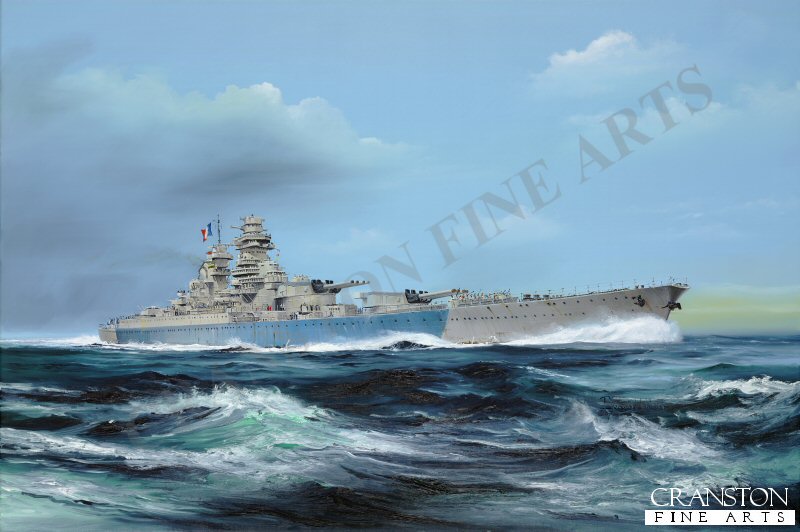
Richelieu at Sea by Randall Wilson. (GL) Richelieu in the Indian Ocean, 1945. |
Big Tailed Beast by Stan Stokes. On July 24, 1945, Air Group 87 on board the USS Ticonderoga was informed that the Hyuga, anchored off a small island near Kure, Japan, would be its target. The ship, a WW I vintage battleship which had been modernized in 1936, and later converted to part battleship and part sea plane tender, would be a formidable objective with its impressive firepower and the fact that its location would place the attackers in the line of fire of numerous shore batteries. The ship was 704 feet in length, displaced 39,000 tons, and carried a compliment of Aichi E16A1 Zuiun reconaissance aircraft which were code named Paul by the Allies. Lt Cdr. Kanaga would lead the squadrons Curtiss SB2C Helldivers on the attack. Each of the twelve Helldivers would carry a 1,000 pound bomb in the internal bomb bay, a 260 pound fragmentation bomb under one wing and a droppable wing tank under the other wing. The drop tank weighed substantially more than the 260 pounder so it was anticipated that the Helldivers might be a bit unstable on takeoff. The first aircraft launched, that of Lt. Al Matteson, went into a immediate hard right turn given the uneven wing loading, and hit the water hard. The other Helldivers managed to become airborne, and eventually joined up for the outbound leg of the mission. The plan was for the Helldivers to dive bomb the Hyuga while torpedo bombers made glide bombing attacks, as the water was too shallow for use of torpedoes. In Stan Stokes painting entitled Big Tailed Beast, an SB2C-4E piloted by Lt. H. Paul Brehm pulls out over its target. Anti-aircraft fire is fierce, and the Hyuga is partially obscured by the incredible amount of smoke being generated by its AA guns. Lt. Brehm has decided to make his dive without dive flaps, hoping to make himself a faster moving target for the Hyugas gunners. During Brehms dive, the SB2C of Lt. Vaughn, which was immediately in front of him, went straight down, crashing next to the Hyuga in a great splash of white foam. Brehm released his bomb and pulled out very low over the target. He momentarily blacked out, and his windscreen fogged over. Brehm and his gunner W. Tommy Thompson, could feel the jolt from their 1000 pounder as it scored a direct hit. Returning to their Task Force low on fuel and in bad weather, Brehm was forced to ditch his Helldiver, but he and Thompson were rescued within minutes by the USS Chauncey. The mission was successful, but was not without cost as more than half the attacking Helldivers failed to return safely. The Curtiss SB2C was the last combat aircraft produced by Curtiss-Wright for the US Navy. The aircraft entered service in late 1943 supplementing the Navys SBD Dauntless dive bomber force. More than 7,000 of these large single engine aircraft were produced, with the most widely produced variant being the SB2C-4. Helldivers were capable of carrying a 2,000 pound bomb load, and could also be modified to be used in the torpedo bombing role. Referred to as The Big Tailed Beast by many of its pilots, the Helldiver had a top speed approaching 280-MPH, but also had the reputation of being one of the most difficult carrier based aircraft to land. As a result, many of the Helldivers lost during the War were victims of landing accidents. |
HMS Warspite by Ivan Berryman. Popularly known as The Old Lady, Warspite was launched on 26th November 1913 and was still fulfilling a crucial role at the end of World War II. Even after being paid off, she escaped being broken up by going aground at Mounts Bay whilst on tow to the breakers yard. During the two world wars, Warspite accumulated fourteen Battle Honours including Jutland May 1916. She is shown in company with HMS Royal Sovereign in the Mediterranean in May 1940 when she was Fleet Flag. |
Attack on the Tirpitz by Stan Stokes. On November 2, 1936 the keel was laid for a new German 35,000 ton-class battleship. On April 1, 1939 the new ship was christened the Tirpitz, and by February of 1941 the giant ship had entered service. The hull of the Tirpitz was 90% welded, and the battleship was very heavily armored, rendering it almost unsinkable in the minds of German naval strategists. In service the Tirpitz actually displaced closer to 53,000 tons. With a crew slightly in excess of 2,000 the ship was capable of making 29 knots. With a range of more than 9,000 miles at a speed of 16 knots, the Tirpitz was certain to take a heavy toll on Allied shipping in the North Atlantic. The Royal Navy and RAF determined that the Tirpitz must never be allowed to become an effective convoy buster, and a multi-year campaign of harassment of the huge German warship was undertaken. In July of 1940, while the ship was still being outfitted, an air attack was launched with little significant damage. After completing its sea trials the Tirpitz was based at the Faettenfjord in Norway. The Tirpitz unsuccessfully attacked two convoys in March of 1942, and itself was attacked by a flight of 12 Albacore torpedo bombers. Three more bombing attacks by Halifax and Lancaster bombers took place in March and April with only marginal success. In July the Tirpitz was moved to Altafjord, and in that month it again attacked a convoy with no success. In October the great ship was sent back to Faeteenfjord for servicing. In 1943 several midget submarine attacks were launched at the battleship, but again with no meaningful impact. No air attacks took place in 1943. In early 1944 the Tirpitz was the target for Soviet bombers, but once again the ship pulled through unscathed. In April of 1944 the Brits once again joined the attack and the Royal Navy sent a large group of 40 Barracudas with about 40 escort fighters to attack the battleship at Kaalfjord. This attack resulted in fifteen hits, generated 400 casualties, and did some serious damage to the upper deck. Follow-up air attacks were called off by bad weather, and it was not until August that three more raids took place. None of these had much impact. In September the Brits changed strategies and commenced attacks on the Tirpitz using 11,000-pound Tallboy bombs. A flight of 32 Lancasters delivered 29 Tallboys to the target in November of 1944. Two direct hits and one near miss were recorded. The great battleships armored deck was pierced by the huge bombs, its magazine exploded, and the ship capsized and sunk with more than 1200 killed. In Stan Stokes painting the attack of April 3, 1944 that was code-named Operation Tungsten is depicted. The Fairey Barracuda despite an ungainly appearance was produced in large numbers (2,500) for use as Royal Navy dive and torpedo bombers. With a crew of 3 and a top speed of only 238-MPH the Barracuda required fighter support during most of its missions to prevent it from becoming an easy target for Axis fighters. |
The Graf Spee by Simon Atack The pocket-battleship Graf Spee catches the flood tide, making speed through a choppy cross-current as she leaves the German naval port of Wilhelmshaven for final trials a few weeks before the outbreak of war on 3rd September, 1939. Under her Captain, Hans Langsdorf, she will soon be on station in the South Atlantic in readiness for action against merchant shipping, vital to the survival of island Britain. |
Bismarck at Hamburg by Ivan Berryman. Bismarck, now complete and newly painted in full Baltic camouflage, returns to Hamburg for the last time as the harsh winter of 1940/41 relents and the pride of the German Kriegsmarine prepares for real action. In the distance, the pre-Dreadnought Schleswig-Holstein awaits her next commission, the old ship alternating between vital ice-breaker and air defence duties at this time. |
HMS Repulse by Ivan Berryman. Wearing her unusual black and white disruptive colour scheme, HMS Repulse is pictured as part of Force Z in company with HMS Prince of Wales and the destroyer Vampire. These two mighty battleships were to be lost within hours of each other, the victims of intense Japanese air strikes. Vampire and the destroyer Electra were on hand to pick up survivors from both ships. |
| Navigation | |
| Page 3 of 7 | Previous .. Page 3 .. Next |
|
Contact Details |
|
Sign Up To Our Newsletter!
This website is owned by Cranston Fine Arts. Torwood House, Torwoodhill Road, Rhu, Helensburgh, Scotland, G848LE Contact: Tel: (+44) (0) 1436 820269. Email: cranstonorders -at- outlook.com
|
|
|