|
|
|
|
|
 |
|
|
|
|
|
|
|
|
Modern Naval Ships Print List
Cranston Military Prints  By Subject Naval Art Modern Era By Subject Naval Art Modern Era  Modern Era Naval Print List Modern Era Naval Print List |
[UP] - Yangtse Incident - Ships - Modern Era Naval Print List |
| Post War naval art. Complete list of prints depicting the ships of the modern era after WW2. |
| Navigation | |
| Page 4 of 7 | Previous .. Page 4 .. Next |
|
|
|
|
|
|
|
|
|
|
|
|
|
|
|
|
|
|
|
|
| Navigation | |
| Page 4 of 7 | Previous .. Page 4 .. Next |
| Text for the above items : |
Fast Cats by Stan Stokes. The F8F Bearcat and the F7F Tigercat were the final family members in Grummans fabulous series of prop driven USN fighter aircraft. The F7F Tigercat evolved from the work of a three-man design team at Grumman, which included Bob Hall, Dick Hutton, and Gordon Israel. The Navy gave an OK to the development of a prototype in mid-1941, however it would not be until April 1944 that the first production Tigercat was delivered. The Navy planned to use the first two hundred F7Fs as night fighters, but due to unsatisfactory carrier suitability trials; the decision was made to scale back the order and equip only shore-based Marine squadrons with this aircraft. Performance tests of the first production F7Fs were impressive. The F7F was almost 80-MPH faster than an F4U Corsair in level flight at sea level. As WW II wound down, the USN changed its plans for the F7F. Newer variants were developed with the most common being the F7F-3N. The 3N was the first F7F to pass carrier qualification on the USS Shangri La in February of 1946. The final variant was the F7F-4N that included a taller rudder, a stronger wing and fuselage, and improved landing gear and tailhook. During the Korean War these aircraft were utilized in the night fighter role. The F8F was the successor to the successful F6F Hellcat fighter which was the US Navys primary fighter during most of WW II. Grummans test pilot, Bob Hall recommended to Grummans President that the successor to the F6F be small and lightweight and faster than anything flying at that time. In competition with both Curtis and Boeing, the Grumman design utilized a 2,100-HP Pratt and Whitney radial engine driving an enormous propeller more than twelve feet in diameter. The prop was so large that the Bearcat needed very tall landing gear. During its early testing the Bearcat was capable of speeds in excess of 440-MPH. The F8F was ordered into production in mid-1944, and the Navy wanted all the Bearcats it could get before November of 1945, which was the presumed date for an invasion of Japan. One interesting design feature of the initial production Bearcats was a break-away section at each wing tip, which was designed to break-off if overstressed, in order to prevent a catastrophic failure of the complete wing. Also unique was the utilization of a bubble canopy, the first on a Navy aircraft. On February 17, 1945 LCDR Robert Elder flew the F8F in its first carrier suitability trials on the USS Charger. Despite terrible weather conditions, Elder made fifteen successful arrested landings. The F8F passed these trials with flying colors. Too late to see action in WW II, the F8F would also see service in Korea, in both the reconnaissance and night fighting roles. In Stan Stokes painting an F8F accompanies an F7F-4N during the carrier qualification of the F7F-4N on the USS Franklin Roosevelt (CV-42) in 1946. |
USS Coral Sea by Ivan Berryman. USS Coral Sea (CV-43 being replenished by fast combat support ship USS Seattle (DE-3) as two of the carriers compliment of F.4s of VF-111 The Sundowners makes a low pass. |
RMS Queen Elizabeth - Fit for a Queen by Gordon Bauwens. In 1946 the daunting task of restoring Queen Elizabeth from grey troop carrier into the stateliest of liners was shared between the Clyde and Southampton. Cunard allowed John Brown & Co, the Elizabeths builders, just 10 weeks to transform the vessels structure as she lay at anchor at the Tail othe Bank. The most striking aspect of this work, as the liners drab wartime coat was chipped away, was how in stages from bow to stern, she gradually emerged in gleaming Cunard colours. This phase completed, the vessel returned to Southampton to be refitted with her original furnishings and for dry docking. Setting out for Scotland once more, Commodore Bisset learned that Her Majesty Queen Elizabeth, Princess Elizabeth and Margaret Rose would join the revitalised vessel on the Clyde for her trials on October 8. On one run over the measured mile off Arran the Queen, invited by the Commodore, took the wheel while her two daughters recorded the time taken with stop watches. Then, her speed trials over, the ship headed back to the Tail othe Bank where the steamer Queen Mary II would take the Royal Party back to Greenocks Princes Pier. En Route, as the sleek Cunarder cleared the sweeping bend between Gourock and Strone, the early evening sun highlighted her shining new paintwork. Framed by the autumn tinted hills, she shared the moment with PS Jupiter and the little Clyde puffer, Ardfern. |
HMS Dolphin by Ivan Berryman. The nuclear-powered submarine HMS Repulse (S23) manoeuvres in preparation to berth at HMS Dolphin in Portsmouth harbour in the late 1970s. |
HMS Vanguard in the Gareloch by Ivan Berryman. The lead ship of the Royal Navy's Vanguard Class SSBNs, HMS Vanguard (S28) was commissioned on 14th August 1993 and is based at HMNB Clyde at Faslane. |
Three Lions by Ivan Berryman. Representing three distinctive types operated by the Royal Navy in the 1980s, HMS Invincible (RO5) is depicted in company with HMS Naiad (F39), an Ikara Leander frigate and the unique Type 82 destroyer HMS Bristol (D23). |
HMS Ark Royal (1970s Carrier) by Ivan Berryman. HMS Ark Royal was the fourth ship in the Royal Navy to bear this memorable name. By far the most impressive, this mighty ship was built to include the angled flight deck, a revolutionary development at the time, with steam catapult. The end of fixed wing aircraft saw Ark Royal quickly become obsolete, being paid off in 1978. |
HMS Cumberland by Ivan Berryman. The Type 22 Broadsword Class frigate HMS Cumberland (F85) enters Grand Harbour, Malta, during the evacuation of Libyan refugees in the Spring of 2011, during which time she rescued 454 people from the uprising as well as enforcing an arms embargo before returning to her home port of Plymouth in readiness for decommissioning in June 2011. |
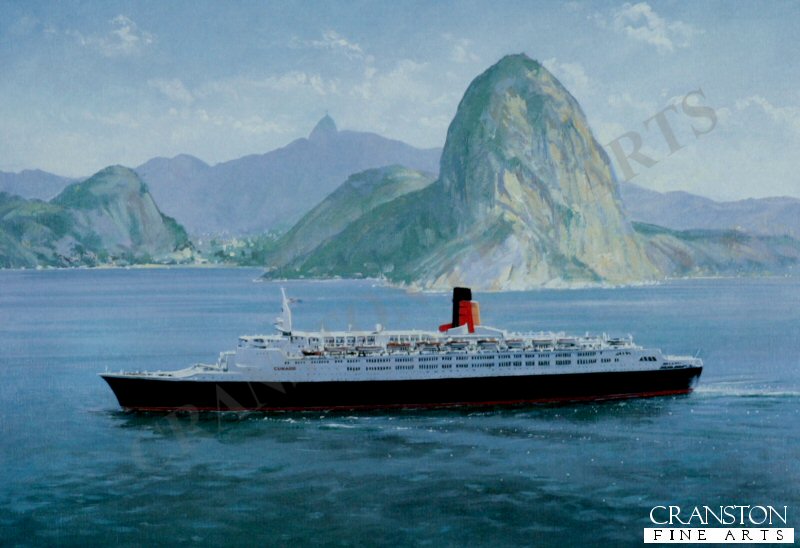
Queen Elizabeth 2 (1969) off Rio De Janeiro by John Young. No text for this item |
Up and Over by Randall Wilson. Westland Wyverns go vertical over HMS Eagle during the Suez Crisis of 1956 |
QE II by Ivan Berryman. Cunard Liner QE II (Queen Elizabeth II) in the late 1980s. The longest serving passenger liner in history, this iconic ship completed her final voyage in November 2008, becoming a permanently moored hotel in Dubai. |
USS Kitty Hawk by Ivan Berryman. USS Kitty Hawk (CV-63) refuels an Adams class Destroyer during a dusk operation off the Vietnam coast as a pair of E8 Crusaders are readied for launch on the forward catapults. |
Tribute to Lt Cdr Eric 'Winkle' Brown by Ivan Berryman. One of the most experienced and respected test pilots in history, Eric 'Winkle' Brown carried out the first landing and take off by a jet aircraft on an aircraft carrier on 3rd December 1945. This was accomplished in the second prototype De Havilland Vampire LZ551/G which had been extensively modified for the sole purpose of carrier operations. Not only was an arrester hook added, but the aircraft featured larger flaps and was fitted with the more powerful Goblin 2 engine. The first take off by a jet from an aircraft carrier is depicted here as Lt Cdr Brown lifts away from the deck of HMS Ocean on that momentous day. |
HMS Glasgow by Ivan Berryman. No text for this item |
NTG03 - Task Force to Iraq by Ivan Berryman. Key ships of the British task force sail in close formation in the Mediterranean sea during the build up to the coalition invasion of Iraq in march 2003, nearest is the flagship HMS Ark Royal with the commando carrier HMS ocean to her port side. other ships include a Type 42 destroyer , the Fleet Auxiliary Fort Victoria and an LSL. |
Good Morning, Spartan by Robert Barbour. Nimrod MR2P from 201 squadron based at RAF Kinloss, climbs away under full power during NATO exercises off the west coast of Scotland. The Nimrod has just completed simulated depth charge attacks on the fleet submarine HMS Spartan and is returning to Kinloss for breakfast. Spartan turns and heads for the Clyde Submarine Base at Faslane on the Gareloch. |
HMS Tireless by Ivan Berryman. Launched in March 1984 and commissioned into the Royal Navy in October the following year, HMS Tireless (S88) was the third of seven Trafalgar Class SSN submarines and is depicted in the Arctic waters near the polar ice cap in 1991. |
Falklands Task Force by Ivan Berryman. Spearheading the Falklands Task Force as it heads south in 1982, the carrier HMS Hermes is shown in company with two Type 21 frigates, HMS Arrow on the left and HMS Ardent in the near foreground. In the far distance, HMS Glamorgan glints in the sun as Type 42 HMS Sheffield cuts across behind Hermes. All pennant numbers were painted out and a vertical black identification stripe applied to all the Type 42s to distinguish them from their Argentine counterparts. |
HMS Daring by Ivan Berryman. Launched on the Clyde on 1st February 2006, HMS Daring was the first of six Type 45 AAW destroyers ordered for the Royal Navy, the type representing a massive leap forward in technology and capability. HMS Daring was officially handed over to the Royal Navy on 10th December 2008 and is depicted here in liaison with a Merlin helicopter. |
| Navigation | |
| Page 4 of 7 | Previous .. Page 4 .. Next |
| List of all modern era ships in our database |
|
Contact Details |
|
Sign Up To Our Newsletter!
This website is owned by Cranston Fine Arts. Torwood House, Torwoodhill Road, Rhu, Helensburgh, Scotland, G848LE Contact: Tel: (+44) (0) 1436 820269. Email: cranstonorders -at- outlook.com
|
|
|