|
|
|
|
|
 |
|
|
|
|
|
|
|
|
World War Two Military Art Print List
Cranston Military Prints  By Subject Military Art World War Two By Subject Military Art World War Two  World War Two Print List World War Two Print List |
[UP] - Anzio - Arnhem - Arras - Battle of The Bulge - Beda Fomm - Berlin - Caumont - Dieppe - Dunkirk - El Alamein - Falaise Gap - Gazala - Guadalcanal - Kowel - Kursk - Medenine - Monte Cassino - Monte Piccolo - Norway - Okinawa - Pagoda Hill - Stalingrad - Tarawa - Targul Fromos - Tobruk - Warsaw - Ardennes - Burma - D-Day - Eastern Front - Italy - Manchuria - North Africa - Pacific - Normandy - World War Two Print List |
| WW2 Military art print collection. Cranston Fine Arts complete list of artwork of second world war military actions. |
| Navigation | |
| Page 5 of 18 | Previous .. Page 5 .. Next |
|
|
|
|
|
|
|
|
|
|
|
|
|
|
|
|
|
|
|
|
|
| Navigation | |
| Page 5 of 18 | Previous .. Page 5 .. Next |
| Text for the above items : |
Pather Tanks at Kursk by Jason Askew. (P) No text for this item |
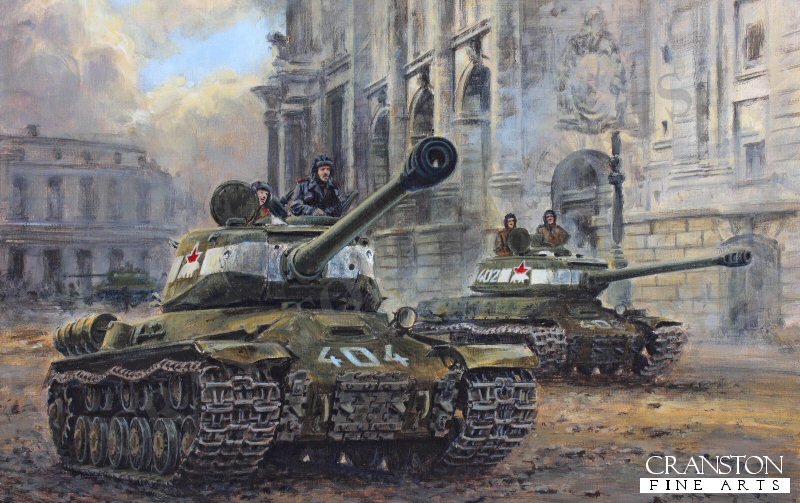
Stalin's Steel Fist by David Pentland. Berlin, Germany, April 1945. Josef Stalin II tanks of the 7th Independent Guards Heavy Tank Brigade, part of Chuykov's 8th Guards Army, make their way carefully through the ruined German capital. The red star and polar bear was to commemorate their part in the recent Karelian campaign. |
Easy Company, 101st Airborne Division by Jason Askew. Paratroopers of Easy Company,101st Airborne Division, take cover in a doorway during the Screaming eagles' penetration of the town of Sainte-Marie-du-Mont, France, on D-Day, June 6, 1944. |
Eastern Front Tiger by Jason Askew. (P) The Tiger tank was one of the most fearsome tanks in the German WW2 armoury. With firepower that could destroy most enemies at long range and armour that could withstand all but the closest of attacks, the Tiger is rightfully regarded as one of the most effective fighting machines of the war. Please note this drawing has a small crease in the lower left border which goes into the image about 2cm. See the photo provided. |
Last of the Honved, Eastern Hungary, Autumn 1944 by David Pentland. Toldi IIa Light tank and troops of the Hungarian Army watch out for marauding enemy aircraft as they move forward to attempt to stem the oncoming Soviet tide. |
Lieutenant George Cairns VC, at the Battle of Pagoda Hill, Burma 13th March 1944 by David Rowlands. Lieut. George Cairns of the South Staffordshire Regiment at the Battle of Pagoda Hill, Burma, 13th March 1944, along with the 3rd/6th Gurkha Rifles. |
First Response by David Pentland. Caen, Normandy, 7th June 1944. Panzer IVGs of 7th Company, 2nd Panzer Battalion, 12th SS Division, supporting Panzer Grenadiers fron the 2nd Battalion, 25th Panzer Grenadier Regiment, in their attack on St Contest and Gamanche. Both objectives were successfully taken, and along with other simultaneous attacks the Canadian advance was stalled in front of Caen. |
Motherland, The Battle of Stalingrad, September 1942 by David Pentland. OT34 Flamethrower tank and men of Col. Krickmans 6th Guards Tank Brigade take part in the Soviet counter attacks of 13th-27th September in defence of the southern factory district of Stalingrad before the final offensive in October. |
Afrika Korps by Jason Askew. (P) A Sd.Kfz.222 and a Panzer IV tank during the combat in North Africa. |
Into the Storm by Ivan Berryman. Typical of the many hundreds of craft that took part in the 6th June 1944 landings at Normandy at the opening of Operation Overlord, these unarmed Royal Navy Landing Craft (LCAs) bravely transported many thousands of British and Canadian infantry to the beaches under the most intense fire. |
The Last Battle, Berlin, 30th April 1945 by David Pentland. Unterscharfurher Karl-Heinz Turk of the Schwere SS Panzerabteilung 503, in one of the units few remaining Kingtigers, defends the Potsdammer Platz along with elements of the Munchberg Division against the rapidly encroaching Soviet forces. |
High Ground at Easy Red by James Dietz. Commemorating the Sixtieth Anniversary of D-Day, 6th June 1944. Omaha beach is four miles long and bordered on each end by two cliffs over 100 feet high. At low tide, wide, hard-packed tidal flats lead upwards from the beach towards commanding bluffs. It was at these bluffs that the men of the US 1st Army would consolidate prior to moving inland into France. But first, the beaches had to be traversed. This scene, commemorating the 60th Anniversary of D-Day, depicts the 743rd Tank Battalion leaving the beaches the evening of June 6th. Their ordeal began over 12 hours earlier. At H-50, the 741st Tank Battalion, scheduled to land in the 16th Infantry's sector suffered a terrible disaster. Of the thirty-two Sherman tanks that debarked 6,000 yards off the eastern half of Omaha beach only six tanks made it to shore. The remainder sank to the bottom of the English Channel due to heavy seas. Someone in the 741st used a tank radio to contact the 743rd Tank Battalion to inform them of their fate, saving the lives and tanks of the 743rd and allowing them to get to shore to protect the infantry. The 743rd Tank Battalion was able to successfully land most of their Sherman's in the initial wave on Omaha's western beaches. They provided invaluable support to both the 116th Infantry and the 16th Infantry on the eastern beaches. The 743rd Tank Battalion left Omaha Beach through both the D-3 exit road and E-1 exit road at St. Laurent-sur-Mer. As one soldier observed, Standing out there on the water beyond all this wreckage was the greatest armada man has ever seen. You simply could not believe the gigantic collection of ships that lay out there waiting to unload. Looking from the bluff, it lay thick and clear to the far horizon of the sea and on beyond, and it spread out to the sides and was miles wide. Its utter enormity would move the hardest man. The landings at Omaha Beach had incurred significant casualties and in fact, the enemy defenses were stronger than expected. Very little progress had been made in the push to the interior and this caused significant backups on the beach. Of the 2,400 tons that were planned to arrive on the beach on D-Day, only 100 tons were delivered. Operations on the 7th and 8th of June would be spent deepening the bridgehead. As the Tankers entered combat to expand the beachhead, few would forecast the hardships that lay ahead in the Norman hedgerows of the Bocage. Though thousands of Americans were spilled onto Omaha beach, the high ground was won by a handful of men who on that day burned with a flame bright beyond common understanding. For its action on June 6th, the 743rd Tank Battalion, commanded by Colonel John Upham, was awarded the Distinguished Unit Citation, French Croix de Guerre and a Bronze Arrowhead in recognition of their participation in the Assault Landing. |
Objective Cairo by David Pentland. Egypt, North Africa, 13th - 20th September 1940. Carro Veloce L3 /33 tankettes and MVSN Blackshirts advance into Egypt from Libya as part of the long awaited offensive by the Italian 5th and 10th Armies in North Africa. |
Michael Wittmann - Battle of Kursk by Jason Askew. (P) Michael Wittman at the battle of Kursk. On the first day of the attack, X-Day, 5th July 1943, eleven Tigers under SS-Hauptsturmfuhrer Kling move northwards to the town of Bykovka, under instructions to break through the Soviet defences located to the south and south-east of the town. The enemy forces, which included T34s, were well placed in ambush positions to thwart the German move. Wittmann's Tiger quickly took out two of the T34s and the remaining enemy vehicles quickly retreated. It was to be a dramatic day for Wittmann and his crew - during the many sorties that were undertaken, loader Walter Koch was hit in the head with splinters and the Tiger drove over a mine, damaging one of the tracks. The injured Koch was replaced by SS-Panzerschutze Max Gaube, and the Tiger was quickly towed to safety. In spite of the small misfortunes that came its way, Wittmann's Tiger had destroyed large amounts of soviet vehicles and armour, including 8 Russian tanks. |
Containing the Baranow Bridgehead, Ukraine, 1st-2nd August 1944 by David Pentland. Leutnant Heinrich Kohlers Stug IIIs of 1st section, 3rd Battery, 322 Stumgeschutz Abteilung, push back repeated Soviet attempts to break out of their bridgehead at Baranow. Within only 2 days they destroyed for 23 enemy tanks. |
British Paratroopers 1943 by Chris Collingwood. No text for this item |
The Hunters by David Pentland. The Fezzan, Libya, North Africa, November, 1942. The Italian Reparto Celere 3 of the 'Raggruppamento Sahariano AS', was the first unit to be equipped with the unique Camionetta 42 'Sahariana'. The platoon was used for patrols and had its first clashes with the LRDG on 17 November, when it lost one Sahariana, and on 25 November, when it succeeded in destroying four out of the eight enemy vehicles it encountered. |
Stug and Motorbike by Jason Askew. (P) Stug Mk.III |
The 2nd Battalion Duke of Wellington's Regiment at the Battle of Sittang Bridge, Burma, February 1942 by David Rowlands. In December 1941, Japan entered the Second World War and invaded southern Burma. 17th Indian Infantry Division withdrew to the Sittang River to prevent the Japanese reaching the bridge first, which would have allowed them free access to Rangoon. 2nd Bn The Duke of Wellington's Regiment was rushed from India to join the rearguard.The river, spanned by the railway bridge, was fast-flowing and nearly 1000 yards wide. The bridge was prepared for demolition. Troops mainly from the Indian Army were defending the bridgehead, having suffered severe casualties during a fighting retreat over many days. By 22nd February the Divisional commander decided that he had little choice but to order the demolition of the bridge, knowing that two-thirds of his Division would be stranded on the far bank.As the two central spans of the bridge were blown, the exhausted troops continued fighting to prevent the Japanese securing the bridgehead. This allowed many troops to continue to cross the bridge with the aid of ropes, and rafts made from anything that would float. Others had to swim. The demolition of the bridge was the greatest disaster in the epic fighting retreat of the small, outnumbered British force in Burma, which covered nearly 1,000 miles in three and a half months. |
Scammell Tractor, Towing a Valentine Tank, North Africa, 1943 by David Rowlands. No text for this item |
Feldwebel Johann Muller - Tigers to the Front by David Pentland. Lake Ladoga, Leningrad 13th January 1943. Feldwebel Muller of 1st Company, Heavy Tank battalion 502, was mentioned in dispatches for his actions in the Second Battle of Lake Ladoga. During the Soviet offensive he accounted for some 25 enemy tanks and by the end of the war he had destroyed 50. |
| Navigation | |
| Page 5 of 18 | Previous .. Page 5 .. Next |
|
Contact Details |
|
Sign Up To Our Newsletter!
This website is owned by Cranston Fine Arts. Torwood House, Torwoodhill Road, Rhu, Helensburgh, Scotland, G848LE Contact: Tel: (+44) (0) 1436 820269. Email: cranstonorders -at- outlook.com
|
|
|