|
|
|
|
|
 |
|
|
|
|
|
|
|
|
Lancaster
Cranston Military Prints  By Subject Aviation Art World War Two By Subject Aviation Art World War Two  Lancaster Lancaster |
| Second World War aviation art prints of the Lancaster aircraft. Our collection of prints and original paintings of the Lancaster aircraft of World War Two. |
| The Avro Lancaster arose from the avro Manchester and the first prototype Lancaster was a converted Manchester with four engines. The Lancaster was first flown in January 1941, and started operations in March 1942. By March 1945 The Royal Air Force had 56 squadrons of Lancasters with the first squadron equipped being No.44 Squadron. During World War Two the Avro Lancaster flew 156,000 sorties and dropped 618,378 tonnes of bombs between 1942 and 1945. Lancaster Bomberss took part in the devastating round-the-clock raids on Hamburg during Air Marshall Harris' "Operation Gomorrah" in July 1943. Just 35 Lancasters completed more than 100 successful operations each, and 3,249 were lost in action. The most successful survivor completed 139 operations, and the Lancaster was scrapped after the war in 1947. A few Lancasters were converted into tankers and the two tanker aircraft were joined by another converted Lancaster and were used in the Berlin Airlift, achieving 757 tanker sorties. A famous Lancaster bombing raid was the 1943 mission, codenamed Operation Chastise, to destroy the dams of the Ruhr Valley. The operation was carried out by 617 Squadron in modified Mk IIIs carrying special drum shaped bouncing bombs designed by Barnes Wallis. Also famous was a series of Lancaster attacks using Tallboy bombs against the German battleship Tirpitz, which first disabled and later sank the ship. The Lancaster bomber was the basis of the new Avro Lincoln bomber, initially known as the Lancaster IV and Lancaster V. (Becoming Lincoln B1 and B2 respectively.) Their Lancastrian airliner was also based on the Lancaster but was not very successful. Other developments were the Avro York and the successful Shackleton which continued in airborne early warning service up to 1992. |
| Navigation | |
| Page 5 of 12 | Previous .. Page 5 .. Next |
|
|
|
|
|
|
|
|
|
|
|
|
|
|
|
|
|
|
|
|
|
| Navigation | |
| Page 5 of 12 | Previous .. Page 5 .. Next |
| Text for the above items : |
Outbound Lancaster by Gerald Coulson. An all time classic image of the Lancaster bomber of Bomber command at altitude crossing the coast on its way to another bombing mission in Europe. In this atmospheric classic image, Gerald Coulson has shown this stalwart of the Royal Air Forces Bomber Command during the second world war. A superb partner painting to the other classic Gerald Coulson image, Off Duty Lancaster. |
Home at Dawn by Nicolas Trudgian. When No 49 Squadron Lancasters bombed the S.S. barracks at Berchtesgaden on 25th April 1945, its aircrews completed a campaign that had begun 5 and a half years earlier in September, 1939. From the very beginning, 49 Squadron were in the thick of the action with one of their pilots, Roderick Learoyd, winning Bomber Commands first Victoria Cross. In 1942 it was Lancasters of 49 Squadron that led the epic raid on Schneider armament and locomotive works at Le Creusot. In 1943 they flew the shuttle-bombing raids to Friedrichshafen and Spezia, attacked the heavily defended rocket sites at Peenemunde, and in preparation for D-Day, bombarded the coastal batteries in Normandy and the V-1 sites in the caves by the river Loire, north of Paris. Later in 1944 the squadron notably took part in the raid on German Baltic Fleet, continuing to fly important bombing missions against the Nazi war machine until the final collapse of the Third Reich. So it was fitting that an RAF squadron whose history went right back to 1916, should make the coupe de grace at Berchtesgarden. Northern Europes short summer nights, with darkness lasting but a few hours, often saw the RAF bomber crews returning to England at dawn, and it is one such scene which is caught up over the river Orwell at Pin Mill, Lancasters of No. 49 Squadron descend low over Suffolk, heading towards their base at Fiskerton. The night raid on Hamburg is almost completed. Spitfires from No. 129 Squadron, based at Hornchurch, having made an early morning attack on German installations in Holland, have picked up the bombers and escorted them home. |
The One That Broke The Dam by Ivan Berryman. Amid a hail of defensive fire, Flt Lt D J H Maltby holds Lancaster ED906/G AJ-J steady for his bomb aimer John Fort to perfectly choose his moment to release the Upkeep Bomb that would ultimately breach and destroy the Mohne Dam during the famous Dambuster raids on the Ruhr on the night of 16th / 17th May 1943. |
Combat Over Domremy by Graeme Lothian. During WW II ofjuly 1944, the RAF Bomber Command were planning yet another bombing raid, this time over Stuttgart in Germany. The no.514 Sq., based in Cambridgeshire, England, were one of the Lancaster Bomber Squadrons chosen for the mission. Flight Lieutenant THOMAS HARVELL was a member of the 7 man crew for Lancaster Bomber no.LM206 selected, (the crew being Flt Lt. Robert Jones, Flt Lt Thomas Harvell, Co-pilot, Flt Lt Kenneth Hedley, Loader, Bomb Aimer, Sgt George Robinson, Navigator (survived) Sgt Robert Lane, Air Gunner, Flt Sgt Frank Stanley Johns, Wireless operator, and Sgt Alfred Braine, Air Gunner.) He was flight engineer and co-pilot with II missions already behind him. The RAF carried out nearly all their raids at night. This was the night of July 28/29 1944 and they were on course in the vicinity of Neuf Chateau (S.WNancy) France. Suddenly they were attacked by a prowling Luftwaffe Nightfighter aircraft, which later proved to be a JUNKERS 88 flown by HEINZ ROKKER. The Lancaster shuddered on the first hit but continued flying. THOMAS HARVELL was moving to the back of the aircraft and had dropped window, (strips of foil) to confuse ground radar, when they were hit again. This time they lost an engine after an explosion and LM206 started to plunge earthwards. (The Merlin Engine can been seen today at the French Airforce museum, St.Dizier, Lorraine) FI.Lt. HOMAS HARVELL was literally blown out of the doomed Lancaster, hitting his head and becoming unconcious. As luck was on his side, he regained his senses whilst falling through the air and pulled his chute at the last minute. He landed heavily and injured his leg. The pilot and four other members of the crew perished but navigator George Robinson also managed to use his chute and was captured after landing, by the german occupation forces. George Robinson now lives in South Africa. The other five crew members are all buried at Neuf Chateau and their graves can be seen to this day. THOMAS HARVELL was able to evade capture and was found by a member of the FFI (French Resistance), who hid him in various hideouts. After being treated for his wounds by Dr.CORNU, a prominent surgeon of Neuf Chateau, several attempts were made to smuggle THOMAS HARVELL back to England without much success. It was decided, by the FFI, to make one last attempt and this time THOMAS HARVELL was given a bicycle and new identity papers. He was told to cycle in the direction of the Swiss border west of Besacon and make contact with the Daubs area FFI commander, JEAN LAPPRAND.It was decided it was too dangerous to cross the border at this time and as THOMAS HARVELL had already become a member of the French Resistance, he continued fighting the war side by side with his French Resistance colleagues. It was in this part of France, that he witnessed a trial of a double agent/traitor of the FFI, who was quickly executed by firing squad. At this point in time, OREST BILAK came into the picture. He was born in Ukraine and had joined the Ukranian Army in 1942. He had become a senior NCO officer when his whole battalion were ordered to join forces with a german SS unit. They had much fighting experience and took part in some very bloody battles. Some elements of the Ukranian people had, at first, welcomed the germans but this soon changed and sometime in 1944 many were deserting. This was the case with OREST BILAKs battalion who had just been ordered to march into the mountain stronghold of JEAN LAPPRAND and wipe them out. Instead they had killed their german SS commanders and after talks with JEAN LAPPRAND had fought on with the FFI including THOMAS HARVELL. Together they liberated the region including the town of PIERREFONTAINE, ahead of the advancing allied forces Sept. 1944. It could be said that THOMAS HARVELL was the only British serviceman who fought with the german SS without being called a traitor. Another RAF pilot, Paul Bell a canadian and THOMAS HARVELL were now able to make contact with the 711 US Army. After six weeks, including a ride in the Dakota of General Patch, they finally made it back to England. On his arrival, THOMAS HARVELL became an instructor/advisor until the end of the war. He later made a career in the British Police Force. He regularily travels to France to meet all his wartime colleagues and now lives in Southampton, England. OREST BILAK was demobilised in 1946. Around this time he met his future wife (in France) who was also Ukrainian and had been working during the war in underground factories for the germans. By pure chance they had both attended the same school in Ukrainia. After the war OREST BILAK made a career in the clothing industry They live in retirement at a small mountain village near Lyon, France. They have 10 grandchildren. He has also devoted much of his time and money for a childrens home, in France, for the underprivileged from Ukraine. Out of his battalion of 450 men, of those who survived, 230 stayed with the French Foreign Legion, some emigrated to Canada, USA and Australia. 116 returned to the Ukraine, only to be arrested and sent to a Siberian prison for 10 years and a further 10 years hard labour. OREST BILAK and his wife visited the Ukraine for the first time in 1994 and met some of their old colleagues. JEAN LAPPRAND remains, to this day, secretive about his time in the FFI. Without a doubt he was very lucky to survive the war, considering his responsibility and fame. After the war he had his own carpentry business and lives in retirement with his wife at Pierrefontaine in good health. After much research we were able to trace and find HEINZ ROKKER, the Luftwaffe pilot who shot down Lancaster LM 206. We had a remarkable reunion at Neuf Chateau on September 14th 1999, where Thomas Harvell and Heinz Rokker met for the first time. It was a civic event with official invitation from the town mayor. A visit was made to the cemetery where the five Lancaster crew members are buried and HEINZ ROKKER laid a wreath on behalf of the german Nightfighters Pilots Association. This was followed by a speech at the town hall. A magnificent feast finished the event at the restaurant next to DOMREMY. |
Night Raiders by Stan Stokes. Anxious to retaliate against German bombing raids on Great Britain, the RAF devised a strategic bombing strategy of its own. Sir Arthur Harris, Chief of the RAFs Bomber Command, stated: The Nazis entered this war with the rather childish delusion that they were going to bomb everyone, and nobody was going to bomb them...they sowed the wind, and now they are going to reap the whirlwind. The Avro Lancaster Mk. B.I. heavy bomber, certainly one of the most important aircraft of World War II, played a major role in the British retaliation. The 7,366 Lancasters which were produced completed 156,000 missions, and because of their large payload dropped a total of 608,612 tons of bombs. The Lancaster evolved from the twin engine Manchester medium bomber which was modified to accept four engines. The Lancasters success stemmed partially from its large payload. Specially modified Lancasters were capable of carrying the 22,000 pound Grand Slam bomb. The Lancaster was operated by a crew of seven or eight, had a maximum speed of 286 MPH, and a range of 2,527 miles. The Lancaster was powered by four 1,640 HP Rolls Royce Merlin water cooled in-line engines. Lancasters were heavily armed with either eight or ten 7.7 MM Colt-Browning machine guns, but they proved no match for the Luftwaffes experienced fighter pilots, and the Lancasters were decimated during daytime bombing raids on Germany. The RAF responded by shifting to a policy of night time strategic bombing, and by wars end most major German cities lay in rubble. The Lancaster was simply built, easy to repair, and could absorb heavy damage. The aircraft underwent very little major alteration during its life. Both the wings and fuselage were designed in large independent sections which bolted together, which dramatically enhanced the repair of damaged aircraft. In Night Raiders, Stan Stokes captures an Avro Lancaster during one of the first night raids on Berlin. Illuminated by the full moon above and the incendiary fires below, the destructive terror of this weapon of war is vividly captured by the artist. As the war progressed Germany improved the effectiveness of its night fighter force and it was not uncommon for losses on any mission to be in the 5-10% range. The whirlwind was not without cost to the RAF. Very few RAF Lancaster crews successfully survived their tours of duty, and in 1942-43 the average life expectancy of a Lancaster aircraft was only 6-7 missions. Despite this high price, the RAFs bombing campaign against Germany clearly hastened the end of the War. |
Operation Chastise by Tony Sargeant. No text for this item |
Legends of the Air by Philip West. Probably the most famous RAF Squadron in history, mainly due to the audacious Dambuster raid in 1943. Other notably successful missions flying their Avro Lancaster bombers included precision raids on the mighty German battleship Tirpitz, U-boat pens, railways, V-weapons sites, canals and bridges. Through their skill and bravery 617 Sqn. crews received many high honours including V.Cs for Wing Commander Guy Gibson and Wing Commander Leonard Cheshire. |
Tonight We Make History by Keith Aspinall. Guy Gibson, Micky Martin and John Hopgood outward bound from Scampton on the evening of 16th May 1943. |
Night of Strong Winds by David Pentland. Berlin, Germany, 24th March 1944. While taking part in what was to be the last major RAF bombing raid on the German capital, Avro Lancaster AS-C of 166 Squadron was unlucky to have both port engines hit by flak. As the crew prepared to bale out, the aircraft again came under fire, this time by an enemy nightfighter. Knocked unconscious by one of the fighters shells, mid gunner Sgt. W.H. Burnell was trapped in the doomed bomber as it fell to the ground from 25,000 ft. Unbelievably he survived and apart from bruising his only injury was a gashed head from the stray shell. |
Lancaster BIIIs of 61 Sqn RAF by Keith Woodcock. No text for this item |
Enemy Coast Ahead by M A Kinnear. Avro Lancaster W4118 (ZN-Y) piloted by Wing Commander G.P. Gibson CO of 106 squadron en-route to attack Schneider Armament works at Le Creusot in 1942. |
The Dambusters by Simon Smith. On the night of 16/17th May 1943,under a full moon, 19 specially modified Lancaster bombers from 617 Squadron carried out one of the most daring and effective air raids of the Second World War. Led by wing commander Guy Gibson the 19 aircraft took off and headed for Germany at extreme low level.. Their mission, code named Operation Chastise, was to destroy the Ruhr dams which supplied water and electricity to the industrial heart of Reich. Each aircraft carried the ingenious Upkeep mine, developed by the engineer Barnes Wallis. Shaped like a large oil drum, the bomb was spun prior to release at exactly 60ft above the water and 150 yards from the dam wall. This caused the weapon to bounce across water and on impact would also make it stay close to the wall of the dam as it sank. The bomb, technically a mine, was fitted with a hydrostatic fuse similar to a depth charge causing detonation at the required depth.The correct height above the water was achieved by aligning the beams of two spotlights to meet on the surface of the water. Delivering such a weapon on target at night at such low altitude and under enemy fire was thought by many to be impossible. The nineteen pilots,some as young as eighteen had been hand picked by Gibson only two months before and formed into 617 squadron whose first mission was to remain top secret and unknown to them up until the last moment. The Mohne Dam was attacked first and several attempts were made under heavy fire with one lancaster being shot down as it flew over the target.Guy Gibson then attempted to draw fire away from the attacking aircraft by switching on his navigation lights and flying to one side of Mick Martins aircraft ,the scene depicted in Simon Smiths painting.Just as another aircraft was about to go in,excited shouts came over the intercom - its gone! The main target achieved, Gibson led the remaining aircraft on to the Eder Dam deep amongst the mountains of the Eder valley. Here, although no flak defenses, the terrain made the approach extremely hazardous. Two bombs were released yet still the target remained unbreached leaving only one last aircraft ,that of Les Knights to attack. A steep descent from a thousand feet then a dive over a spit of land left very little time to line up and release the bomb.Worse still there was a huge mountain on the far side of the dam! Added to this Edward Johnson the bomb aimer recalled that the spinning bomb had an alarming gyroscopic effect on the handling of the aircraft,so it was with superb flying and teamwork that their bomb struck and finally destroyed the massive stonework of the Eder Dam. Gibsons leadership and bravery led to the award of the VC and many other decorations were bestowed upon the other crews.The squadron however paid a heavy price with 8 lancasters being lost. |
617 Squadron Outbound to the Ruhr by Ivan Berryman. Viewed from the cockpit, Lancasters of 617 Sqn Dambusters form up at the beginning of their perilous journey to the Ruhr Valley on the night of 16th May 1943 when the Möhne and Eder dams were breached under the codename Operation Chastise. |
Crewing Up by Graeme Lothian. Crew of Lancasters 101 Squadron RAF, stand chatting and drinking cups of tea supplied by the WMCA vans. Delays in Ops for an hour or so allow the crews a chance to light up and have a cup of tea. 101 Squadron based at Ludford Magna were a squadron with a difference, from 1943 the Lancasters were fitted with special radio jamming equipment known as ABC or AirBorne Cigar and carried an eighth crew member known as the special duties operator. Squadron letters were SR and targeted by the Luftwaffe fighters giving 101 Squadron the highest casualty rating in Bomber Command. |
The Long Journey Home by Adrian Rigby. The Avro lancatser, the backbone of the Royal Air Force Bomber Command during world war two. The Avro Lancaster was a development from the Avro Manchester, and with its four Rolls Royce Merlin engines it was able to carry a substantial bomb load. The Lancaster entered service in 1942, with 44 Squadron based at RAF Waddington and 97 Squadron based at RAF Woodhall Spa. Superior range and payload capability meant the Lancaster was able to strike at the heart of Germany and the factories of their war machine. |
Enemy Coast Ahead by Simon Atack. Lancaster of 617 Sqn carrying its cargo of the Barnes-Wallace bouncing bomb on its way to its target of Germanys western dams. The Dambusters raid was to become one of the most celebrated missions ever carried out. |
Forming Up by Randall Wilson. (GL) Lancasters - B1 R5689 VN-N 50th Squadron RAF leads a gaggle of Lancs as they gain altitude to form up over the English coast. |
The Attack on Villers Bocage by Ivan Berryman. Lancasters of No.15 Squadron are shown releasing their bombs during the attack against German armour that had amassed in and near the French village of Villers Bocage on 30th June 1944. ED395 (LS-M), piloted by Fl Off W Hall, is in the background with LM473 (LS-P) in the foreground, flown by Fl Sgt N Overend. The village was almost completely obliterated during the bombing raid and the operation was deemed a tactical success. |
Tribute to Walter Briegleb by Ivan Berryman. Walter Briegleb is shown in his Ju88 G.7 4R+BR as he stalks his prey - on this occasion a Lancaster. Flying below their target, his crew would aim upward firing cannon at the inner wing of the bomber, igniting the fuel tanks. For the bomber crews, they were very much defenceless against this type of attack, and often had no idea of the presence of an enemy aircraft in the dark. |
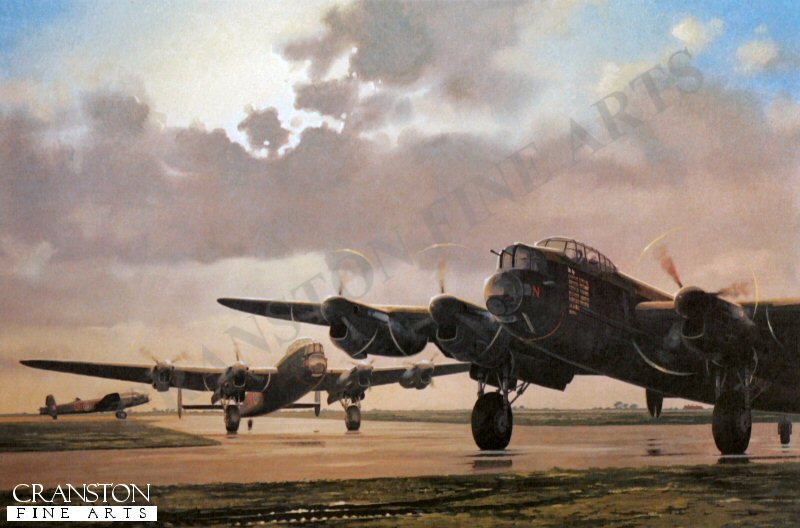
Operations On by Philip West. The evening mist begins to settle on the bleak airfield at Ludford Magna, Lincolnshire, as Lancaster aircraft of 101 Squadron taxi out for another dangerous nighttime sortie. The nature of their assignments during the war was a closely guarded secret. The unusual aerials on the front and top of the aircraft were used for intercepting and jamming messages between German fighter aircraft and their ground control. |
Moonlight Hunter by Nicolas Trudgian. As the air war raged over Berlin and other German cities, night-fighter units such as NJG100, the original Eastern front night fighter Geschwader, were redeployed nearer home in the final desperate defence of Germany. By late 1944 the Luftwaffes night fighting aircraft were being flown by experienced crews using sophisticated electronic equipment and, though fighting a losing battle, had become the scourge of the RAFs night raiders. A Junkers Ju88 G-6, piloted by major Paul Zorner, Gruppenkommandeur III./NJG100, based at Stubendorf, intercepts and badly damages a four-engined Lancaster of R.A.F. Bomber Command over Germany in late 1944. Shedding debris and trailing flames, there may just be time for the crew to bale out before the mightly bomber falls away into the dark abyss. With the aid of his FuG220 and upward firing Schrage Musik armament, Zorner has stalked his prey, and attacked from beneath unseen. The crew of this Lancaster didn't stand a chance, and with the moonlight briefly glinting on his aircraft, the accomplished Ju88 pilot slips away into the darkness of the night. |
| Navigation | |
| Page 5 of 12 | Previous .. Page 5 .. Next |
|
Contact Details |
|
Sign Up To Our Newsletter!
This website is owned by Cranston Fine Arts. Torwood House, Torwoodhill Road, Rhu, Helensburgh, Scotland, G848LE Contact: Tel: (+44) (0) 1436 820269. Email: cranstonorders -at- outlook.com
|
|
|